




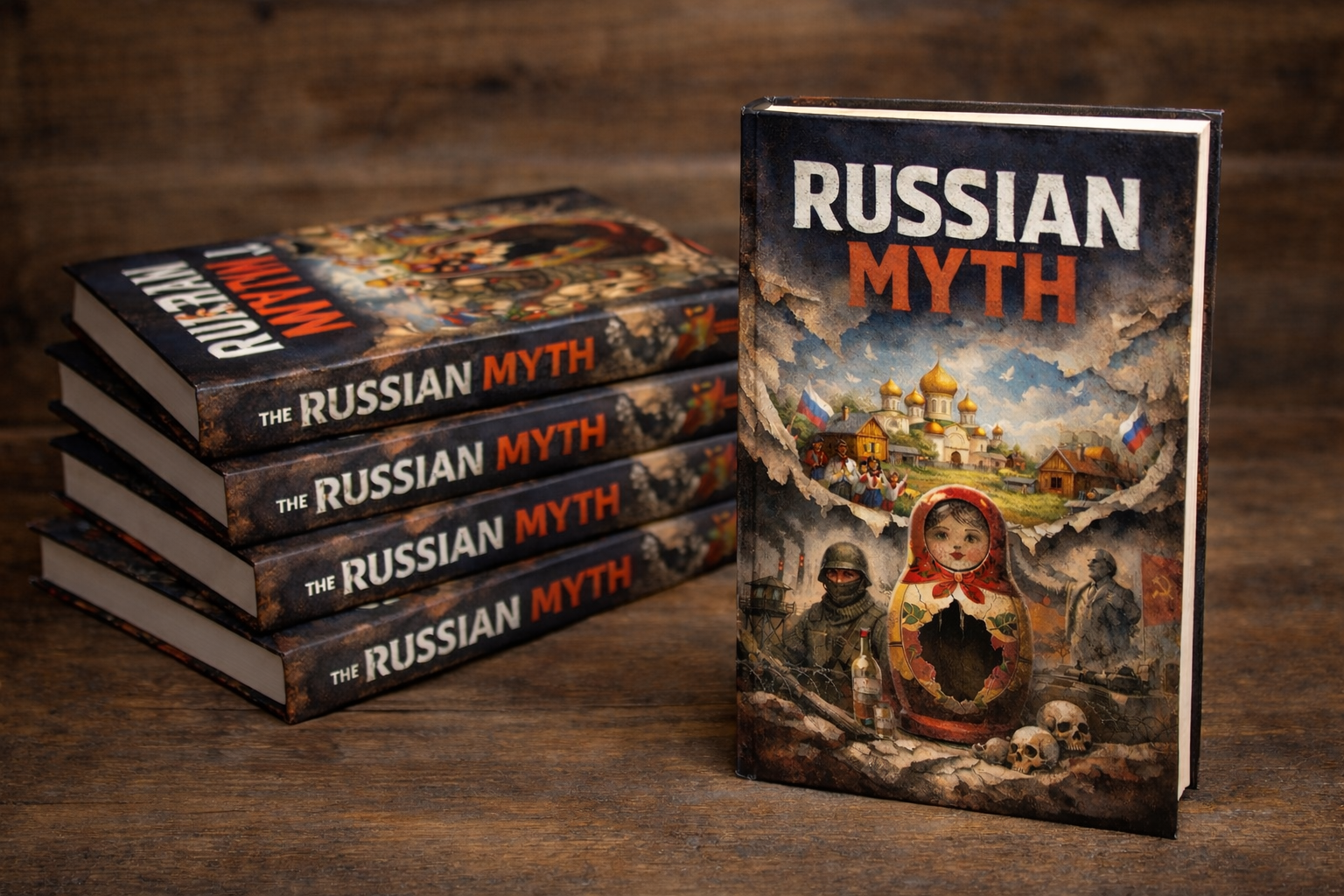
The dominant frameworks for interpreting Russian political behavior – democratization theory, authoritarian resilience studies, civilizational analysis – share a common deficiency: they treat Russia as a variant of a recognizable state form. Oleh Cheslavskyi’s The Russian Myth proposes a fundamentally different starting point.
Drawing on Giovanni Arrighi’s theory of systemic cycles of capital accumulation, Cheslavskyi reconstructs eight centuries of Muscovite history as the history of a comprador system – an institutional apparatus designed not to govern a society but to extract its resources on behalf of successive external hegemons. The Mongol Horde, Venetian commercial capital, British imperial finance, American postwar hegemony: each provided the external anchor for Moscow’s internal order. The ruler functioned not as a sovereign in the Weberian sense but as a rent-distribution mechanism, sustained by ideological structures – chief among them the Russian Orthodox Church – that transformed political obedience into religious obligation.
This framework reframes the question of Russian statehood entirely. What Western observers identify as dysfunction – the absence of independent courts, the substitution of legal procedure with personal loyalty networks, the systematic destruction of civil society – is not failure. It is the system operating as designed.
The book assigns Ukraine a precise analytical role: it is the first post-Soviet society to demonstrate that the Muscovite model is neither inevitable nor universal for Slavic peoples. Ukraine’s trajectory toward European legal and civic norms constitutes a structural challenge to the Russian myth’s foundational premise. The war is the system’s response to a proof of concept it cannot tolerate.
Cheslavskyi concludes that the present moment represents a structural rupture without historical precedent: the simultaneous erosion of the system’s informational, economic, and geopolitical foundations.
Cheslavskyi writes as both a historian and a practitioner of investigative journalism – a combination that gives the book unusual analytical density without sacrificing readability. The argument is built cumulatively, moving from the formation of Muscovite statehood in the thirteenth century through the present conflict, tracking the same comprador logic across radically different historical contexts. For scholars of Russian and Eastern European history, international relations theorists, and policy analysts seeking a framework that goes beyond regime-type classification, The Russian Myth offers a genuinely original contribution to the literature on Eurasian political economy and imperial collapse.
The Russian Myth available on Amazon.